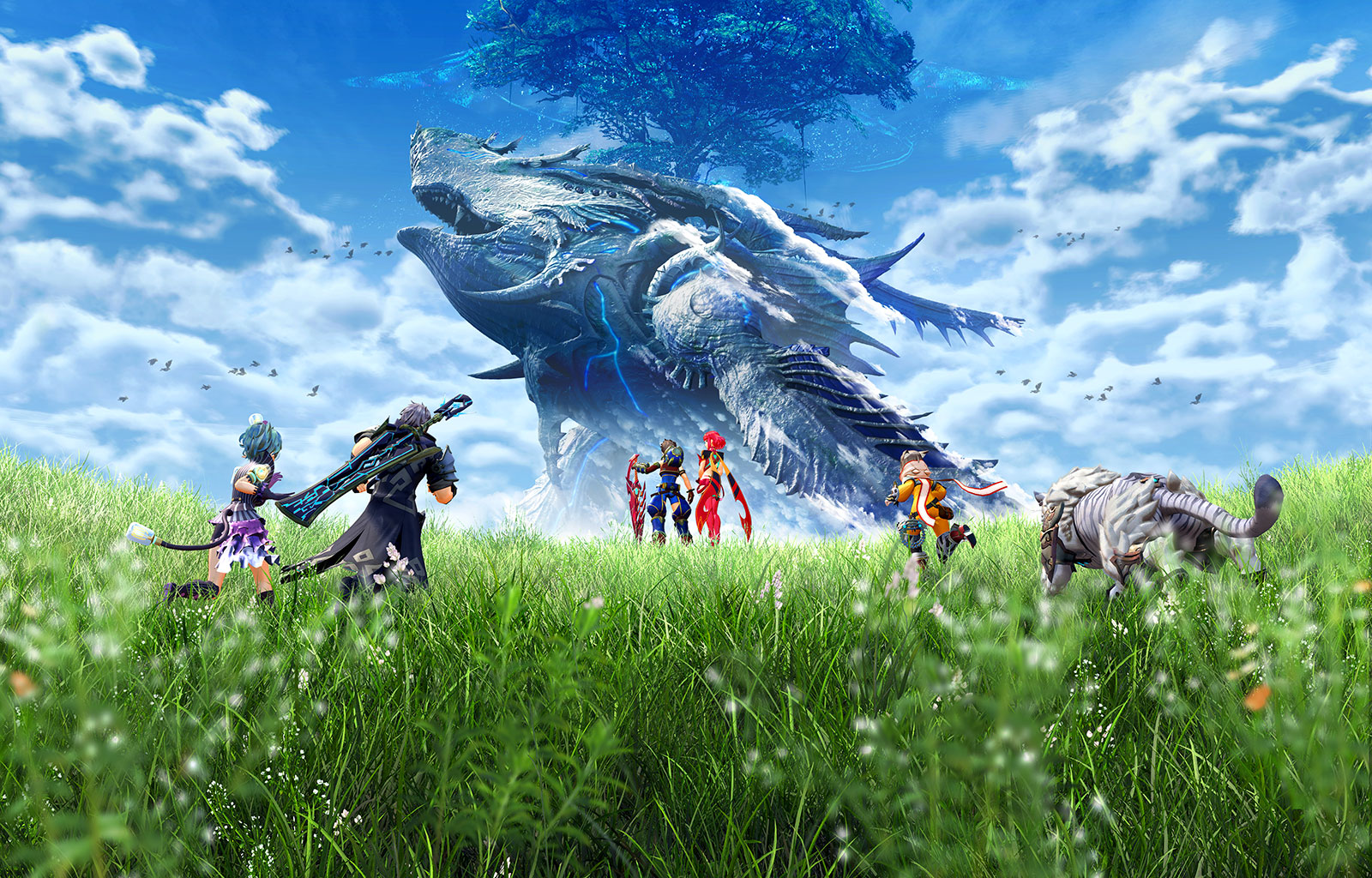
Digital Foundry has published a technical deep dive on the new Nintendo Switch 2 Edition of Xenoblade Chronicles 2, comparing the upgraded release to the original Nintendo Switch version.
Developed by Monolith Soft and first released for the Nintendo Switch in December 2017, Xenoblade Chronicles 2 returns in this refreshed edition with a number of image-quality and performance changes that the analysis documents in detail.
Digital Foundry reports that the Switch 2 Edition delivers clearer edges, improved edge stability, and richer texture detail compared with the original Switch release.
The outlet's pixel-count inspection suggests the game renders internally at roughly 720p on docked mode, and Digital Foundry notes the final output appears to use temporal upsampling techniques — possibly combined with a spatial upscaler or another proprietary upscaling method — to reach a more 4K-like final image.
On vegetation and lighting, Digital Foundry observes that grass appears higher resolution and is more liberally placed, depth-of-field effects can extend with reduced blur, bloom has been lessened, and ambient occlusion is more localized.
One scene in the analysis also appears substantially relit, and pre-rendered sequences look to be delivered at a higher bitrate than in the original Switch release.
Performance is a major focus of the report.
Digital Foundry confirms Xenoblade Chronicles 2 on the original Nintendo Switch ran at 30 FPS with occasional dips during traversal and in cutscenes.
On the Switch 2 Edition, the title mostly targets 60 FPS but still shows dropped frames during heavy traversal sections, alpha-heavy effects, and certain cutscenes.
The analysis highlights the use of double-buffered VSync on Switch 2: when CPU/GPU work exceeds the frame budget, the engine drops to a 33ms frame delivery window until load normalizes.
Handheld performance is markedly different between platforms.
Digital Foundry notes that on the original Switch handheld mode the game ran at around 360p with an aggressive sharpening filter, while the Switch 2 Edition presents a 1080p-like handheld image with stable edges and improved image treatment.
The outlet estimates an internal handheld render near 468p on Switch 2 and reports 60 FPS handheld performance that nonetheless experiences the same occasional dips seen in docked mode.
A minor line artifact in handheld mode is also flagged in the analysis.
Beyond pure visuals and performance, Digital Foundry points out that a gameplay-impacting improvement was implemented in the Switch 2 Edition, and separate coverage has detailed that change.
The report also cautions that players have identified a couple of issues in the new release.
For the full technical breakdown and side-by-side clips, Digital Foundry's video and write-up remain the primary source for developers and players interested in the nitty-gritty of the Switch 2 Edition's upgrades.
Developed by Monolith Soft and first released for the Nintendo Switch in December 2017, Xenoblade Chronicles 2 returns in this refreshed edition with a number of image-quality and performance changes that the analysis documents in detail.
Digital Foundry reports that the Switch 2 Edition delivers clearer edges, improved edge stability, and richer texture detail compared with the original Switch release.
The outlet's pixel-count inspection suggests the game renders internally at roughly 720p on docked mode, and Digital Foundry notes the final output appears to use temporal upsampling techniques — possibly combined with a spatial upscaler or another proprietary upscaling method — to reach a more 4K-like final image.
On vegetation and lighting, Digital Foundry observes that grass appears higher resolution and is more liberally placed, depth-of-field effects can extend with reduced blur, bloom has been lessened, and ambient occlusion is more localized.
One scene in the analysis also appears substantially relit, and pre-rendered sequences look to be delivered at a higher bitrate than in the original Switch release.
Performance is a major focus of the report.
Digital Foundry confirms Xenoblade Chronicles 2 on the original Nintendo Switch ran at 30 FPS with occasional dips during traversal and in cutscenes.
On the Switch 2 Edition, the title mostly targets 60 FPS but still shows dropped frames during heavy traversal sections, alpha-heavy effects, and certain cutscenes.
The analysis highlights the use of double-buffered VSync on Switch 2: when CPU/GPU work exceeds the frame budget, the engine drops to a 33ms frame delivery window until load normalizes.
Handheld performance is markedly different between platforms.
Digital Foundry notes that on the original Switch handheld mode the game ran at around 360p with an aggressive sharpening filter, while the Switch 2 Edition presents a 1080p-like handheld image with stable edges and improved image treatment.
The outlet estimates an internal handheld render near 468p on Switch 2 and reports 60 FPS handheld performance that nonetheless experiences the same occasional dips seen in docked mode.
A minor line artifact in handheld mode is also flagged in the analysis.
Beyond pure visuals and performance, Digital Foundry points out that a gameplay-impacting improvement was implemented in the Switch 2 Edition, and separate coverage has detailed that change.
The report also cautions that players have identified a couple of issues in the new release.
For the full technical breakdown and side-by-side clips, Digital Foundry's video and write-up remain the primary source for developers and players interested in the nitty-gritty of the Switch 2 Edition's upgrades.