Retroports' GoldenEye 007 SNES demo reignites debate over AI in retro development
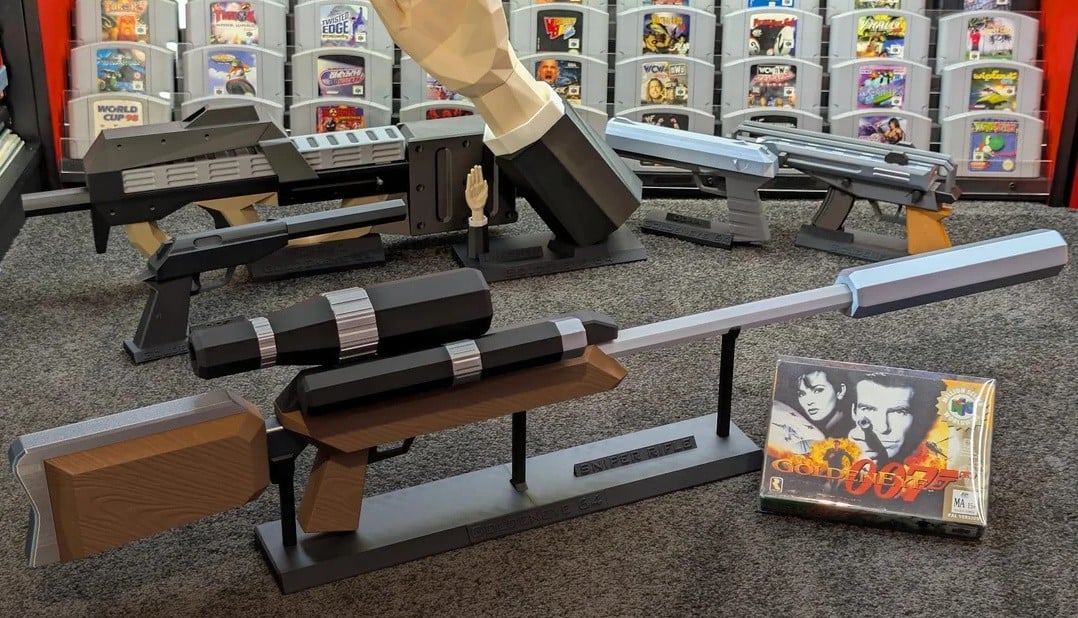
A new demo claiming to run GoldenEye 007 on Super Nintendo hardware has landed in the retro-gaming spotlight.
The original GoldenEye 007 was developed by Rare and released for the Nintendo 64 in 1997; the franchise remains one of the most discussed examples of 3D design on Nintendo hardware.
Over the weekend, developer retroports published footage showing what appears to be the N64 classic's opening level rendered on SNES-era technology, prompting both admiration and skepticism across social channels.
According to retroports, the demonstration uses a polygon-based rendering pipeline with fog and occlusion-culling techniques.
The developer clarified that the clip is limited to the first stage because of texture constraints, and emphasized the footage was not a pre-rendered video but rendered live in the SNES emulator MESEN while emulating a 2MB SuperFX2 coprocessor.
The Super FX family of chips historically enabled early SNES titles to display 3D effects, most famously in Star Fox-era projects.
retroports also disclosed that AI tools were used during development.
The team said they relied primarily on a model called Claude Opus and used Chat-GPT Astra to resolve specific bugs.
The developer paid public respect to original hardware programmers, noting that people who coded native 3D rendering on constrained consoles are the true experts and expressing hope that veteran creators could build on or improve such efforts.
Reaction has been mixed.
Some community members praised the technical achievement and optimization effort required to approximate N64-style visuals on SNES-era pipelines.
Others expressed skepticism about the demo's legitimacy without a distributable ROM for independent verification, and criticized the growing trend of AI-assisted, “vibe-coded” releases that, in their view, can trivialize manual craftsmanship.
The episode underscores several verified tensions in today's scene: homebrew developers increasingly leverage emulators and AI-assisted tooling, while purists emphasize transparency, reproducible builds, and respect for original techniques.
It also highlights broader concerns that have been raised about AI in software creation — including debugging challenges for untrained coders, the dependence on models trained on human work, and environmental and ethical considerations tied to large-scale AI tooling.
As with many high-profile retro demos, further verification—such as a testable ROM or more technical breakdowns—will determine whether this GoldenEye 007 SNES demonstration is a breakthrough port or an impressive proof-of-concept running in an emulator environment.
Meanwhile, the story has already reignited conversation about emulation, homebrew, and the role of AI in preserving and reimagining classic games for platforms including PC and community-driven Switch homebrew scenes.
A new demo claiming to run GoldenEye 007 on Super Nintendo hardware has landed in the retro-gaming spotlight.
The original GoldenEye 007 was developed by Rare and released for the Nintendo 64 in 1997; the franchise remains one of the most discussed examples of 3D design on Nintendo hardware.
Over the weekend, developer retroports published footage showing what appears to be the N64 classic's opening level rendered on SNES-era technology, prompting both admiration and skepticism across social channels.
According to retroports, the demonstration uses a polygon-based rendering pipeline with fog and occlusion-culling techniques.
The developer clarified that the clip is limited to the first stage because of texture constraints, and emphasized the footage was not a pre-rendered video but rendered live in the SNES emulator MESEN while emulating a 2MB SuperFX2 coprocessor.
The Super FX family of chips historically enabled early SNES titles to display 3D effects, most famously in Star Fox-era projects.
retroports also disclosed that AI tools were used during development.
The team said they relied primarily on a model called Claude Opus and used Chat-GPT Astra to resolve specific bugs.
The developer paid public respect to original hardware programmers, noting that people who coded native 3D rendering on constrained consoles are the true experts and expressing hope that veteran creators could build on or improve such efforts.
Reaction has been mixed.
Some community members praised the technical achievement and optimization effort required to approximate N64-style visuals on SNES-era pipelines.
Others expressed skepticism about the demo's legitimacy without a distributable ROM for independent verification, and criticized the growing trend of AI-assisted, “vibe-coded” releases that, in their view, can trivialize manual craftsmanship.
The episode underscores several verified tensions in today's scene: homebrew developers increasingly leverage emulators and AI-assisted tooling, while purists emphasize transparency, reproducible builds, and respect for original techniques.
It also highlights broader concerns that have been raised about AI in software creation — including debugging challenges for untrained coders, the dependence on models trained on human work, and environmental and ethical considerations tied to large-scale AI tooling.
As with many high-profile retro demos, further verification—such as a testable ROM or more technical breakdowns—will determine whether this GoldenEye 007 SNES demonstration is a breakthrough port or an impressive proof-of-concept running in an emulator environment.
Meanwhile, the story has already reignited conversation about emulation, homebrew, and the role of AI in preserving and reimagining classic games for platforms including PC and community-driven Switch homebrew scenes.