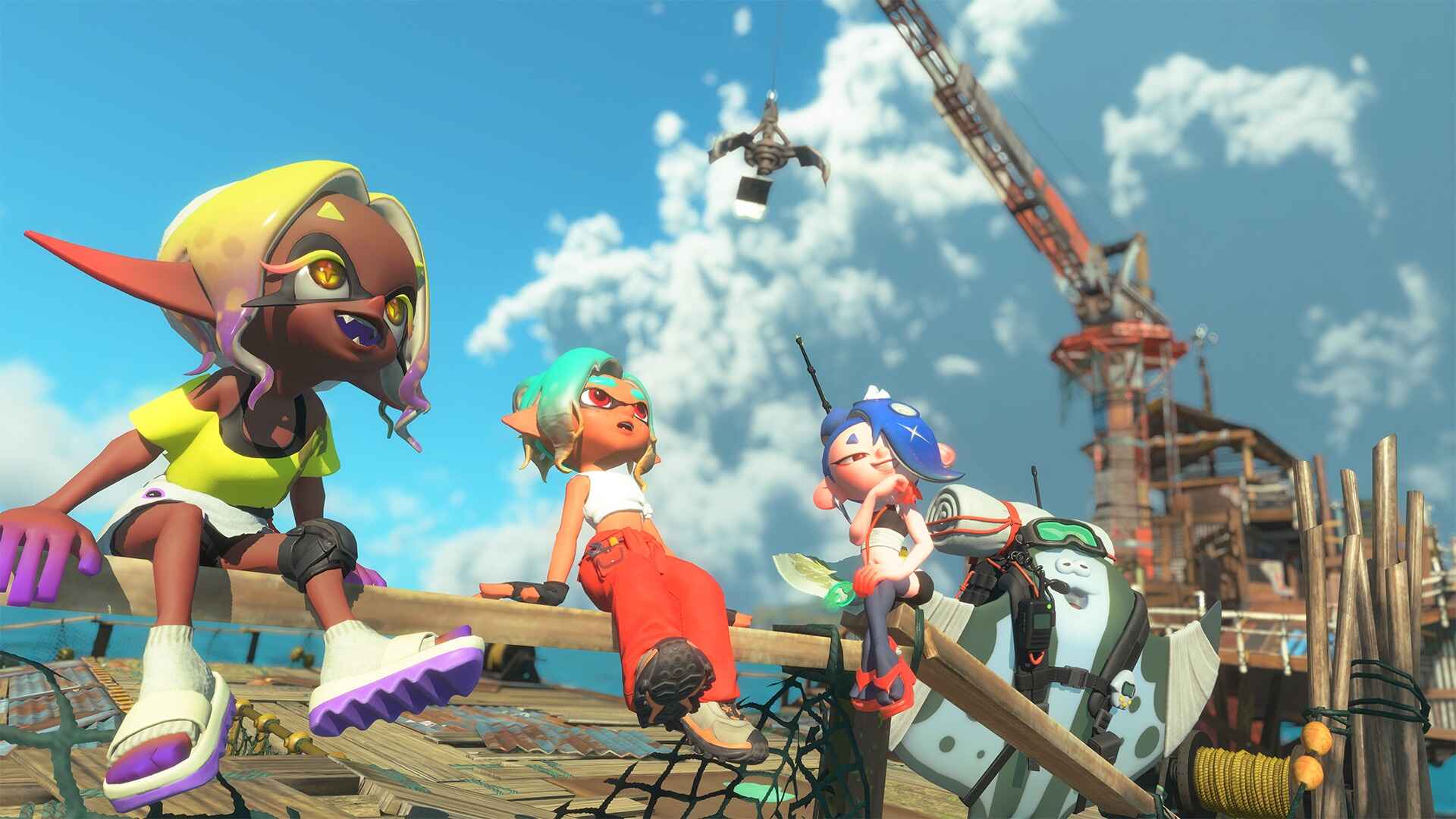
Splatoon Raiders arrives July 23, 2026 as a Nintendo Switch 2 exclusive, and a recent installment of Nintendo’s Ask the Developer series (volume 22) sheds light on why the team set the spin-off on the Spirhalite Islands and how the new hardware shaped the project.
This interview was conducted before the game’s release and translated from the original Japanese.
Developers walked through world design, enemy behavior, music direction, and how Nintendo leveraged Nintendo Switch 2 capabilities to realize a different kind of Splatoon experience.
A deliberate island choice
Developers told Nintendo’s Ask the Developer series they intentionally made the game’s setting a remote archipelago.
Lead designer Ito explained that because Splatoon Raiders is a spin-off distinct from the urban worlds of earlier entries, the team opted for uninhabited islands to create both geographic separation and gameplay synergy.
The island location also enabled systems where simple gadgets and weapons are customized using items washed ashore.
Building for Nintendo Switch 2
Design staff said porting the project to Nintendo Switch 2 allowed them to prioritize organic environments—grass, curved terrain, and natural lighting—elements that were harder to render convincingly on prior hardware.
Ito noted the team specifically added the ability to ink grassy surfaces, expanding interaction beyond the inorganic, vertical-heavy stages familiar from Splatoon and Splatoon 3.
Shifting tone: from resort to ‘outlandish environment’
The team originally explored a bright, resort-like aesthetic with playful Salmonids, but feedback during prototyping made them reconsider.
Sonoyama summarized that testers found the early visual direction emotionally off-putting—players sympathized with the cute Salmonids and felt uneasy about taking their treasures.
The developers consequently reoriented the art and sound toward what they call an “outlandish environment.”
Paraphrasing the team’s reasoning: placing players in a bizarre, unsettling setting helps justify challenging encounters and repeat failures as part of the intended loop—lose, learn, and return stronger.
To achieve that, artists reworked lighting, props, and terrain, adding weathering, rust, and strange debris so the islands felt uncanny rather than idyllic.
Music and Salmonid behavior
Composer and sound staff described a deliberate pivot in the game’s audio.
Rather than band-driven pop familiar from urban stages, the team crafted tracks that imagine local Salmonid music—techno, dub, and minimal influences rendered with found objects—to create an unsettling score that still propels gameplay.
The developers also confirmed continuity with series elements: Salmon Run’s instrumentation influence remains, and a new Salmonid band—related to Salmon Run’s ω-3—appears to bolster the foes’ morale.
Salt, names, and enemy design
Developers explained that in-game “salt” on the Spirhalite Islands has properties that make Salmonids more aggressive, and that many new enemy names function as practical shorthand used by players on the job—a parallel to Salmon Run’s callouts.
The team emphasized the title’s concept of raiding: players enter Salmonid-infested, outlandish locales to find meaningful rewards.
With Splatoon Raiders set for July 23, 2026 on Nintendo Switch 2, Nintendo’s internal developers say they leaned on the new hardware and a revised aesthetic to deliver a Splatoon spin-off that preserves series DNA while exploring a darker, stranger island world.
This interview was conducted before the game’s release and translated from the original Japanese.
Developers walked through world design, enemy behavior, music direction, and how Nintendo leveraged Nintendo Switch 2 capabilities to realize a different kind of Splatoon experience.
A deliberate island choice
Developers told Nintendo’s Ask the Developer series they intentionally made the game’s setting a remote archipelago.
Lead designer Ito explained that because Splatoon Raiders is a spin-off distinct from the urban worlds of earlier entries, the team opted for uninhabited islands to create both geographic separation and gameplay synergy.
The island location also enabled systems where simple gadgets and weapons are customized using items washed ashore.
Building for Nintendo Switch 2
Design staff said porting the project to Nintendo Switch 2 allowed them to prioritize organic environments—grass, curved terrain, and natural lighting—elements that were harder to render convincingly on prior hardware.
Ito noted the team specifically added the ability to ink grassy surfaces, expanding interaction beyond the inorganic, vertical-heavy stages familiar from Splatoon and Splatoon 3.
Shifting tone: from resort to ‘outlandish environment’
The team originally explored a bright, resort-like aesthetic with playful Salmonids, but feedback during prototyping made them reconsider.
Sonoyama summarized that testers found the early visual direction emotionally off-putting—players sympathized with the cute Salmonids and felt uneasy about taking their treasures.
The developers consequently reoriented the art and sound toward what they call an “outlandish environment.”
Paraphrasing the team’s reasoning: placing players in a bizarre, unsettling setting helps justify challenging encounters and repeat failures as part of the intended loop—lose, learn, and return stronger.
To achieve that, artists reworked lighting, props, and terrain, adding weathering, rust, and strange debris so the islands felt uncanny rather than idyllic.
Music and Salmonid behavior
Composer and sound staff described a deliberate pivot in the game’s audio.
Rather than band-driven pop familiar from urban stages, the team crafted tracks that imagine local Salmonid music—techno, dub, and minimal influences rendered with found objects—to create an unsettling score that still propels gameplay.
The developers also confirmed continuity with series elements: Salmon Run’s instrumentation influence remains, and a new Salmonid band—related to Salmon Run’s ω-3—appears to bolster the foes’ morale.
Salt, names, and enemy design
Developers explained that in-game “salt” on the Spirhalite Islands has properties that make Salmonids more aggressive, and that many new enemy names function as practical shorthand used by players on the job—a parallel to Salmon Run’s callouts.
The team emphasized the title’s concept of raiding: players enter Salmonid-infested, outlandish locales to find meaningful rewards.
With Splatoon Raiders set for July 23, 2026 on Nintendo Switch 2, Nintendo’s internal developers say they leaned on the new hardware and a revised aesthetic to deliver a Splatoon spin-off that preserves series DNA while exploring a darker, stranger island world.