
The Sega Action Chair — also known in North America as the Simulator 1 — is back in the spotlight after YouTuber and Sega enthusiast Mike Rouse (Retro Gamer Boy) posted a detailed unboxing and restoration video.
The Action Chair is a rare example of late-20th-century attempts to bring arcade-style motion hardware into the home, following the popularity of Sega's taikan (“body sensation”) arcade cabinets in the 1980s.
Sega's taikan machines, used for titles such as Space Harrier, Galaxy Force and After Burner, employed hydraulics to tilt and roll players in time with on-screen action.
Those arcade experiences inspired a handful of home-focused projects: the unreleased Konix Multisystem explored motion peripherals during its development, and an American company, Simular Technology, produced a consumer chair called the Simulator 1 that used body shifts to translate directional inputs to a console.
Simular Technology marketed the Simulator 1 in North America as compatible with the Nintendo Entertainment System (NES) and the Sega Genesis.
In the UK the hardware was later rebranded and sold under Sega's name as the Action Chair.
Contemporary commentary and user experience show the concept suffered in practice: the chair’s sensor-based input was imprecise, novelty tended to outstrip long-term enjoyment, and the unit’s large physical footprint discouraged many retailers from stocking it, leading to a short retail lifespan.
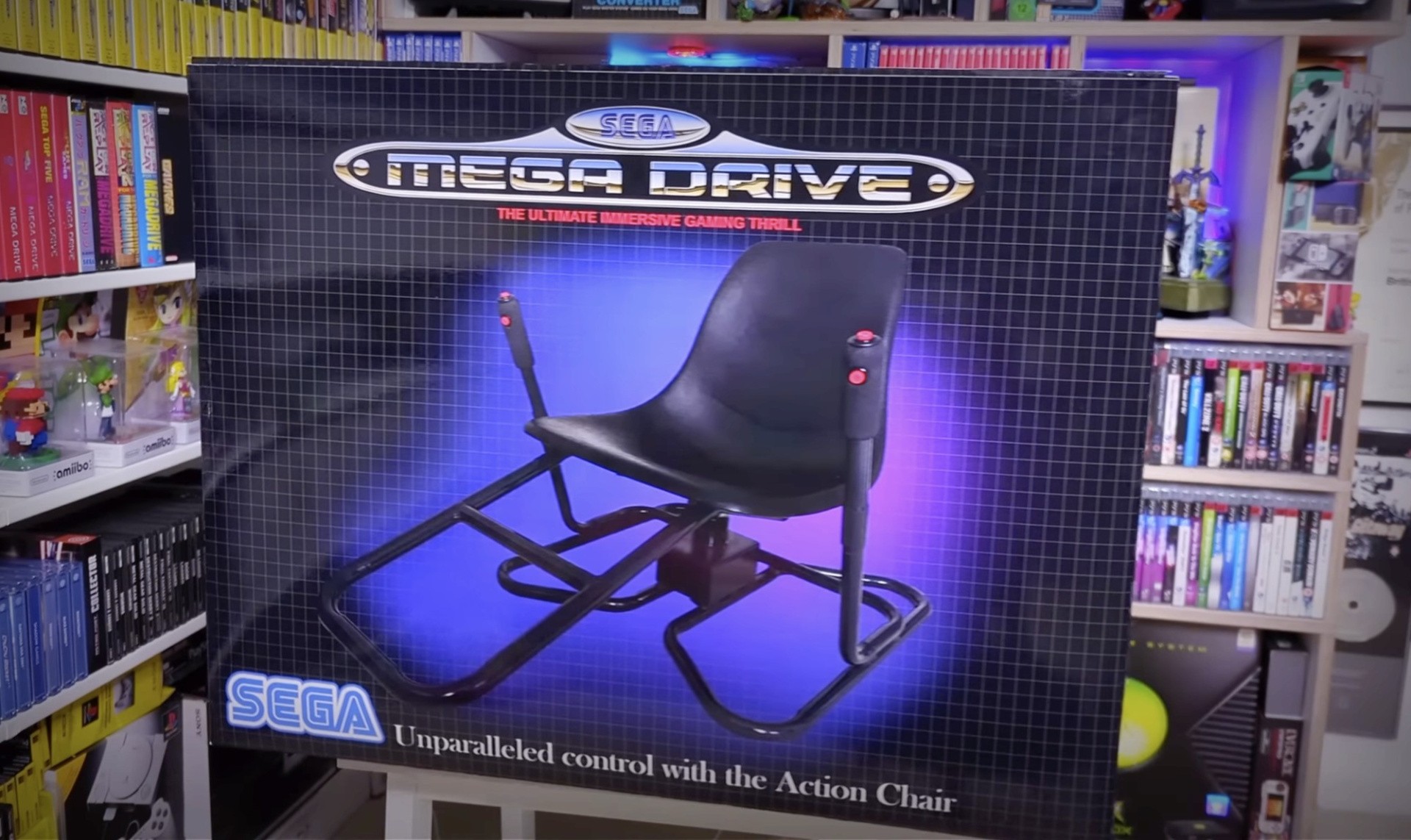
In his video, Rouse documents acquiring an Action Chair online and takes the extra step of creating a bespoke outer box for the unit.
He notes the visual appeal of a properly packaged example: while Sega originally shipped the chair in plain white packaging, Rouse’s custom box presents the product as if it were a polished, retail-ready release.
Rouse also openly acknowledges the hardware’s limitations, describing the Action Chair as awkward to use and better appreciated now as a collectible and piece of hardware history rather than a practical controller.
For collectors and historians of arcade-to-home adaptations, the Action Chair represents a tangible link between arcade motion technology and the experimentation that surrounded home consoles in the late 1980s and early 1990s.
Rouse’s video preserves that story by documenting both the condition of a surviving unit and the cultural context that made such odd peripherals possible.
The Action Chair is a rare example of late-20th-century attempts to bring arcade-style motion hardware into the home, following the popularity of Sega's taikan (“body sensation”) arcade cabinets in the 1980s.
Sega's taikan machines, used for titles such as Space Harrier, Galaxy Force and After Burner, employed hydraulics to tilt and roll players in time with on-screen action.
Those arcade experiences inspired a handful of home-focused projects: the unreleased Konix Multisystem explored motion peripherals during its development, and an American company, Simular Technology, produced a consumer chair called the Simulator 1 that used body shifts to translate directional inputs to a console.
Simular Technology marketed the Simulator 1 in North America as compatible with the Nintendo Entertainment System (NES) and the Sega Genesis.
In the UK the hardware was later rebranded and sold under Sega's name as the Action Chair.
Contemporary commentary and user experience show the concept suffered in practice: the chair’s sensor-based input was imprecise, novelty tended to outstrip long-term enjoyment, and the unit’s large physical footprint discouraged many retailers from stocking it, leading to a short retail lifespan.
In his video, Rouse documents acquiring an Action Chair online and takes the extra step of creating a bespoke outer box for the unit.
He notes the visual appeal of a properly packaged example: while Sega originally shipped the chair in plain white packaging, Rouse’s custom box presents the product as if it were a polished, retail-ready release.
Rouse also openly acknowledges the hardware’s limitations, describing the Action Chair as awkward to use and better appreciated now as a collectible and piece of hardware history rather than a practical controller.
For collectors and historians of arcade-to-home adaptations, the Action Chair represents a tangible link between arcade motion technology and the experimentation that surrounded home consoles in the late 1980s and early 1990s.
Rouse’s video preserves that story by documenting both the condition of a surviving unit and the cultural context that made such odd peripherals possible.