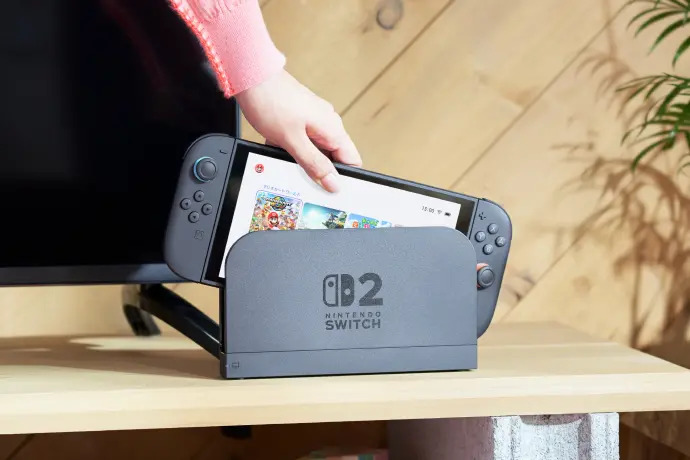
Nintendo has filed a patent for a dock designed to support both the original Nintendo Switch and the newer Nintendo Switch 2 platform, according to reporting from Nintendo Patents Watch.
The original Nintendo Switch launched on March 3, 2017, and its hybrid design has driven a long line of hardware accessories and docks; this newly published patent outlines a dock that can identify which console is connected and adjust its behavior accordingly.
The patent documentation, as summarized by Nintendo Patents Watch, indicates that the two consoles perform USB Power Delivery (PD) negotiation differently.
The dock is described as recognizing the connected system—either the legacy Nintendo Switch or the newer Nintendo Switch 2—and changing its data and video modes and fan operation based on that recognition.
In journalistic terms: the dock will detect which model is attached and switch to the appropriate power, data and cooling profile for that console.
The patent further describes an internal fan whose operation is intended to cool not only the dock assembly but also the connected console.
Rewritten for clarity: the dock’s fan is designed to manage thermal load for both the dock hardware and the inserted console, with fan speed adjusted depending on the detected device.
Key technical distinctions listed in the patent include:
- When a Nintendo Switch 2 is docked: the dock presents a USB 3.x data interface, offers higher-resolution video output, and operates the fan at higher RPMs.
- When an original Nintendo Switch is docked: the dock presents a USB 2.0 data interface, provides a lower-resolution video output, and uses a lower fan RPM profile.
These differences align with known variations in hardware capability and power-delivery behavior between older and newer console designs.
USB 3 and USB 2 refer to established USB data standards; higher-resolution video output is consistent with prior generations of docks that adapt to a console’s display capabilities.
Patents are public records of technical approaches and intellectual property; a filing does not by itself confirm that a product will reach retail.
Still, the filing adds to the public record about how Nintendo is thinking about cross-generational accessory compatibility and thermal management.
For Nintendo Switch owners and accessory makers following Nintendo Direct announcements and eShop launches, the patent offers a concrete view of how future dock hardware might handle multiple console generations.
The original Nintendo Switch launched on March 3, 2017, and its hybrid design has driven a long line of hardware accessories and docks; this newly published patent outlines a dock that can identify which console is connected and adjust its behavior accordingly.
The patent documentation, as summarized by Nintendo Patents Watch, indicates that the two consoles perform USB Power Delivery (PD) negotiation differently.
The dock is described as recognizing the connected system—either the legacy Nintendo Switch or the newer Nintendo Switch 2—and changing its data and video modes and fan operation based on that recognition.
In journalistic terms: the dock will detect which model is attached and switch to the appropriate power, data and cooling profile for that console.
The patent further describes an internal fan whose operation is intended to cool not only the dock assembly but also the connected console.
Rewritten for clarity: the dock’s fan is designed to manage thermal load for both the dock hardware and the inserted console, with fan speed adjusted depending on the detected device.
Key technical distinctions listed in the patent include:
- When a Nintendo Switch 2 is docked: the dock presents a USB 3.x data interface, offers higher-resolution video output, and operates the fan at higher RPMs.
- When an original Nintendo Switch is docked: the dock presents a USB 2.0 data interface, provides a lower-resolution video output, and uses a lower fan RPM profile.
These differences align with known variations in hardware capability and power-delivery behavior between older and newer console designs.
USB 3 and USB 2 refer to established USB data standards; higher-resolution video output is consistent with prior generations of docks that adapt to a console’s display capabilities.
Patents are public records of technical approaches and intellectual property; a filing does not by itself confirm that a product will reach retail.
Still, the filing adds to the public record about how Nintendo is thinking about cross-generational accessory compatibility and thermal management.
For Nintendo Switch owners and accessory makers following Nintendo Direct announcements and eShop launches, the patent offers a concrete view of how future dock hardware might handle multiple console generations.