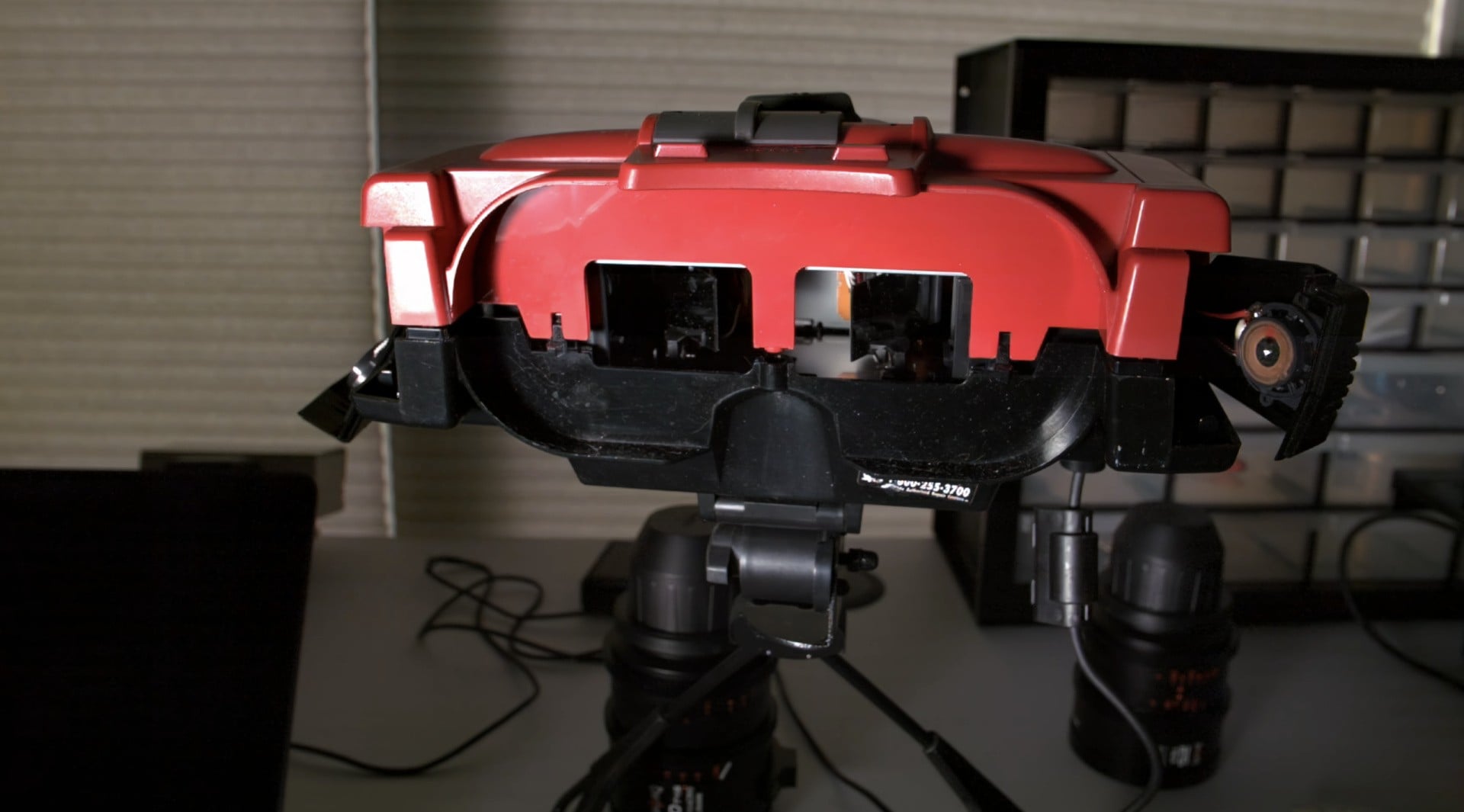
The Nintendo Virtual Boy stands out in gaming history as an ambitious experiment, aiming to introduce stereoscopic 3D to mainstream players.
Launched by Nintendo in 1995 in Japan and the United States, the Virtual Boy was the brainchild of a team led by Gunpei Yokoi, the renowned creator of the Game Boy.
Despite its brief market stint and commercial shortcomings, the system’s technological innovation has continued to draw the fascination of gaming enthusiasts, historians, and hardware aficionados.
Recently, The Slow Mo Guys, a YouTube duo celebrated for their high-speed camera work and in-depth tech analyses, delved into the Virtual Boy’s unique display technology.
Their new feature, released on January 16th, provides a rare, slow-motion look at how the system rendered its iconic red-and-black stereoscopic images—a topic often shrouded in mystery since its release.
The Virtual Boy marked Nintendo’s bold step into stereoscopic 3D, long before the Nintendo 3DS or modern VR headsets.
Unlike typical displays with traditional screens, the Virtual Boy incorporated two LED arrays and ingeniously oscillating mirrors to build up complete images for each eye.
To uncover exactly how this system produced its visuals, The Slow Mo Guys' host, Gavin Free, disassembled the console and filmed it with a Phantom TMX7510 camera capable of capturing up to 1,750,000 frames per second.
In the video, Free clarifies that the Virtual Boy’s display is unlike the miniaturized TV-like screens found in modern VR headsets such as the Meta Quest or Apple Vision Pro.
Instead, each side of the device contains a vertical strip—essentially one column—of 224 red LEDs.
These columns do not show the full image at once; rather, the device uses rapidly vibrating mirrors to sweep this column horizontally.
As they move, they construct a complete 384 by 224 pixel image for each eye, syncing left-to-right and right-to-left passes to deliver its signature 3D effect.
This method not only reduced the hardware’s size and cost, but also delivered the headlining stereoscopic experience, despite the infamous eye strain and monochromatic visuals.
While the Virtual Boy’s commercial run was short-lived due to its high launch price, limited software support, and user discomfort, it has earned a cult reputation among retro game collectors and technology scholars.
Its place in Nintendo’s legacy is further underscored by the company’s continued exploration of 3D gaming experiences, from the Nintendo 3DS to innovative Switch peripherals.
The Slow Mo Guys’ breakdown offers an unprecedented, close-up view of the Virtual Boy’s mechanics, shining a light on the inventive engineering behind this iconic, if misunderstood, console.
For those interested in the intersection of gaming history and hardware engineering, the full analysis is available on their official YouTube channel, providing both entertainment and technical insight for Nintendo fans old and new.
Launched by Nintendo in 1995 in Japan and the United States, the Virtual Boy was the brainchild of a team led by Gunpei Yokoi, the renowned creator of the Game Boy.
Despite its brief market stint and commercial shortcomings, the system’s technological innovation has continued to draw the fascination of gaming enthusiasts, historians, and hardware aficionados.
Recently, The Slow Mo Guys, a YouTube duo celebrated for their high-speed camera work and in-depth tech analyses, delved into the Virtual Boy’s unique display technology.
Their new feature, released on January 16th, provides a rare, slow-motion look at how the system rendered its iconic red-and-black stereoscopic images—a topic often shrouded in mystery since its release.
The Virtual Boy marked Nintendo’s bold step into stereoscopic 3D, long before the Nintendo 3DS or modern VR headsets.
Unlike typical displays with traditional screens, the Virtual Boy incorporated two LED arrays and ingeniously oscillating mirrors to build up complete images for each eye.
To uncover exactly how this system produced its visuals, The Slow Mo Guys' host, Gavin Free, disassembled the console and filmed it with a Phantom TMX7510 camera capable of capturing up to 1,750,000 frames per second.
In the video, Free clarifies that the Virtual Boy’s display is unlike the miniaturized TV-like screens found in modern VR headsets such as the Meta Quest or Apple Vision Pro.
Instead, each side of the device contains a vertical strip—essentially one column—of 224 red LEDs.
These columns do not show the full image at once; rather, the device uses rapidly vibrating mirrors to sweep this column horizontally.
As they move, they construct a complete 384 by 224 pixel image for each eye, syncing left-to-right and right-to-left passes to deliver its signature 3D effect.
This method not only reduced the hardware’s size and cost, but also delivered the headlining stereoscopic experience, despite the infamous eye strain and monochromatic visuals.
While the Virtual Boy’s commercial run was short-lived due to its high launch price, limited software support, and user discomfort, it has earned a cult reputation among retro game collectors and technology scholars.
Its place in Nintendo’s legacy is further underscored by the company’s continued exploration of 3D gaming experiences, from the Nintendo 3DS to innovative Switch peripherals.
The Slow Mo Guys’ breakdown offers an unprecedented, close-up view of the Virtual Boy’s mechanics, shining a light on the inventive engineering behind this iconic, if misunderstood, console.
For those interested in the intersection of gaming history and hardware engineering, the full analysis is available on their official YouTube channel, providing both entertainment and technical insight for Nintendo fans old and new.