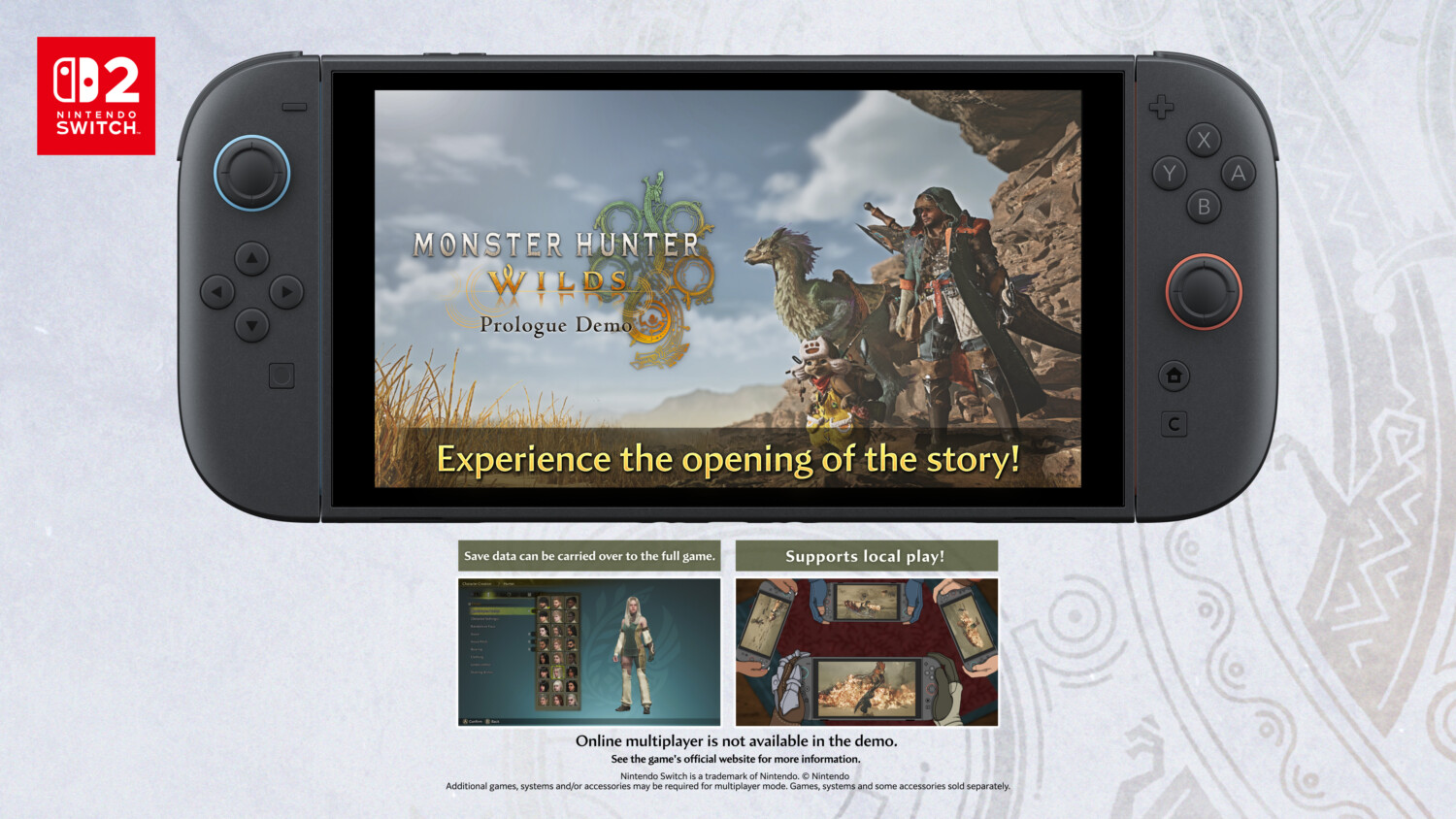
Capcom released a Monster Hunter Wilds Nintendo Switch 2 demo this week, and Digital Foundry has published a technical breakdown analyzing frame rate, resolution, and visual presentation.
Monster Hunter Wilds is developed by Capcom and is scheduled to launch on Nintendo Switch 2 on December 4, 2026; the demo was made available through the eShop ahead of release.
Technical summary
Digital Foundry's analysis of the Switch 2 demo identifies two primary performance targets for docked play: a quality mode capped at 30 frames per second and a frame-rate-focused mode that runs substantially higher.
In journalistic terms, Digital Foundry summarized that the Switch 2 demo "delivers a locked 30 FPS in quality mode, while the alternate frame-rate mode raises performance into the 40–55 FPS range at reduced resolution and with some visual compromises." In handheld play, the demo exposes only a single performance mode.
Resolution, upscaling, and visual trade-offs
According to the analysis, docked quality mode renders internally at roughly 648p and then upscales, while handheld mode targets about 432p and is also upscaled.
Enabling frame-rate mode appears to lower the internal resolution to around 600p and removes screen-space reflections to sustain higher frame pacing.
Digital Foundry reports that Switch 2 offers generally clearer textures and includes screen-space reflections that are absent on the Xbox Series S build of the demo, contributing to a slightly more refined presentation on Switch 2.
However, the report also notes increased shimmer during motion and some reduced geometry or visual detail in places.
Performance and animation
The demo on Nintendo Switch 2 runs a stable 30 FPS in quality mode with no reported frame-pacing issues.
The frame-rate mode sacrifices some rendering features—such as screen-space reflections and higher-resolution shadows—to reach higher frame rates.
Digital Foundry also observed instances of reduced shadows for some environmental elements and characters, simplified models, and limited animation fidelity at distance (for example, distant foliage not animating and occasional simplification of NPC and enemy animation).
Comparison with Xbox Series S
The analysis highlights areas where the Switch 2 demo outperforms the Xbox Series S demo, particularly in texture clarity and the presence of screen-space reflections.
At the same time, both platforms show compromises: Switch 2 favors different trade-offs between clarity, animation, and motion shimmer depending on mode.
What this means for players
For Nintendo Switch 2 owners, the demo suggests Capcom has tuned Monster Hunter Wilds to offer a choice between visual fidelity and smoother frame pacing.
With the full release date set for December 4, 2026, players can expect Capcom to refine these builds further ahead of launch.
For developers and technical observers, Digital Foundry's report provides a clear snapshot of how Capcom is balancing performance and presentation on Nintendo's next-generation handheld-console hybrid.