


Marsupilami 2: Salsa Palombia is the follow-up platformer from Ocellus Studio, published by Microids and released on Nintendo Switch.
The sequel builds on the developer’s previous licensed efforts — including Marsupilami: Hoobadventure and The Smurfs: Dreams — and aims to deliver momentum-based platforming with local co-op support and collectible-driven level design.
Licensed games can be hit-or-miss, but Marsupilami 2 demonstrates that licensed-platformers can still surprise players.
In journalistic terms, the game proves that licensed titles continue to produce noteworthy entries, provided the developer applies focused design work and solid mechanics.
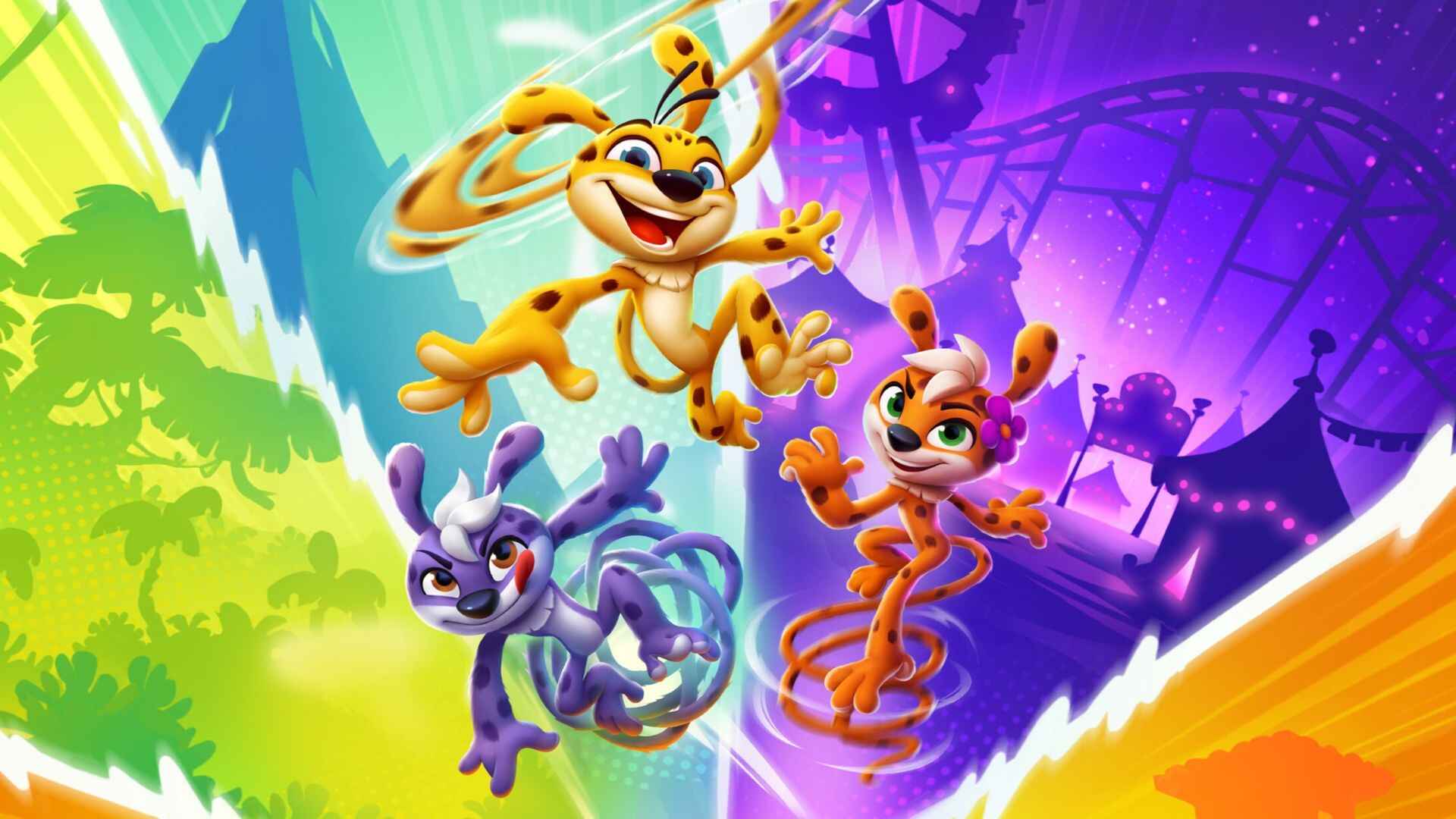
Marsupilami 2 casts players as two of three playable Marsupilamis with distinct movement kits.
The yellow character performs an air dash and can hover with its tail; the orange Marsupilami executes a spinning double jump; the purple form transforms into a bouncy, spike-immune ball.
Players can swap between the two active characters on the fly, and local two-player sessions let each participant control one character.
The core objective in standard stages is straightforward: reach the large fruit at the end.
Basic survival is forgiving — three hits on normal, regular checkpoints, and infinite lives — but progression and completion require more thorough exploration.
Unlocking world bosses depends on collecting musical notes.
Notes are earned by finding hidden caches, reaching fruit-collection thresholds, and completing special stage challenges.
Any cleared level can be replayed in Salsa Mode, a score-focused variant that rewards chaining fruit pickups into combos to gain multipliers and additional music notes.
The design effectively gives each stage two distinct playstyles: a cautious, exploratory first run and a speed- and combo-oriented Salsa Mode run for completionists.
Movement feels deliberate and well-tuned: roll, tail swing, wall-climb, ground-pound, and character swaps enable fluid momentum chains that recall classic platformers.
Boss encounters are multi-phase, requiring players to avoid attacks until weak points open, then capitalize on windows of vulnerability.
These fights are conceptually interesting but constitute the game’s most notable difficulty spikes; failing a phase returns the player to the start of that boss encounter.
Players can adjust difficulty if needed.
Presentation on Nintendo Switch is vibrant and well-animated.
Performance represents an improvement over the studio’s earlier Switch release, though occasional framerate dips can occur.
Audio design is strong, with particularly standout boss music; Marsupilami vocalizations may divide player preferences.
In short, Marsupilami 2: Salsa Palombia is a compact, energetic platformer that will appeal to fans of momentum-heavy 2D platforming.
Version tested: Nintendo Switch.
Review copy provided by Microids.
Score: 8/10.
The sequel builds on the developer’s previous licensed efforts — including Marsupilami: Hoobadventure and The Smurfs: Dreams — and aims to deliver momentum-based platforming with local co-op support and collectible-driven level design.
Licensed games can be hit-or-miss, but Marsupilami 2 demonstrates that licensed-platformers can still surprise players.
In journalistic terms, the game proves that licensed titles continue to produce noteworthy entries, provided the developer applies focused design work and solid mechanics.
Marsupilami 2 casts players as two of three playable Marsupilamis with distinct movement kits.
The yellow character performs an air dash and can hover with its tail; the orange Marsupilami executes a spinning double jump; the purple form transforms into a bouncy, spike-immune ball.
Players can swap between the two active characters on the fly, and local two-player sessions let each participant control one character.
The core objective in standard stages is straightforward: reach the large fruit at the end.
Basic survival is forgiving — three hits on normal, regular checkpoints, and infinite lives — but progression and completion require more thorough exploration.
Unlocking world bosses depends on collecting musical notes.
Notes are earned by finding hidden caches, reaching fruit-collection thresholds, and completing special stage challenges.
Any cleared level can be replayed in Salsa Mode, a score-focused variant that rewards chaining fruit pickups into combos to gain multipliers and additional music notes.
The design effectively gives each stage two distinct playstyles: a cautious, exploratory first run and a speed- and combo-oriented Salsa Mode run for completionists.
Movement feels deliberate and well-tuned: roll, tail swing, wall-climb, ground-pound, and character swaps enable fluid momentum chains that recall classic platformers.
Boss encounters are multi-phase, requiring players to avoid attacks until weak points open, then capitalize on windows of vulnerability.
These fights are conceptually interesting but constitute the game’s most notable difficulty spikes; failing a phase returns the player to the start of that boss encounter.
Players can adjust difficulty if needed.
Presentation on Nintendo Switch is vibrant and well-animated.
Performance represents an improvement over the studio’s earlier Switch release, though occasional framerate dips can occur.
Audio design is strong, with particularly standout boss music; Marsupilami vocalizations may divide player preferences.
In short, Marsupilami 2: Salsa Palombia is a compact, energetic platformer that will appeal to fans of momentum-heavy 2D platforming.
Version tested: Nintendo Switch.
Review copy provided by Microids.
Score: 8/10.