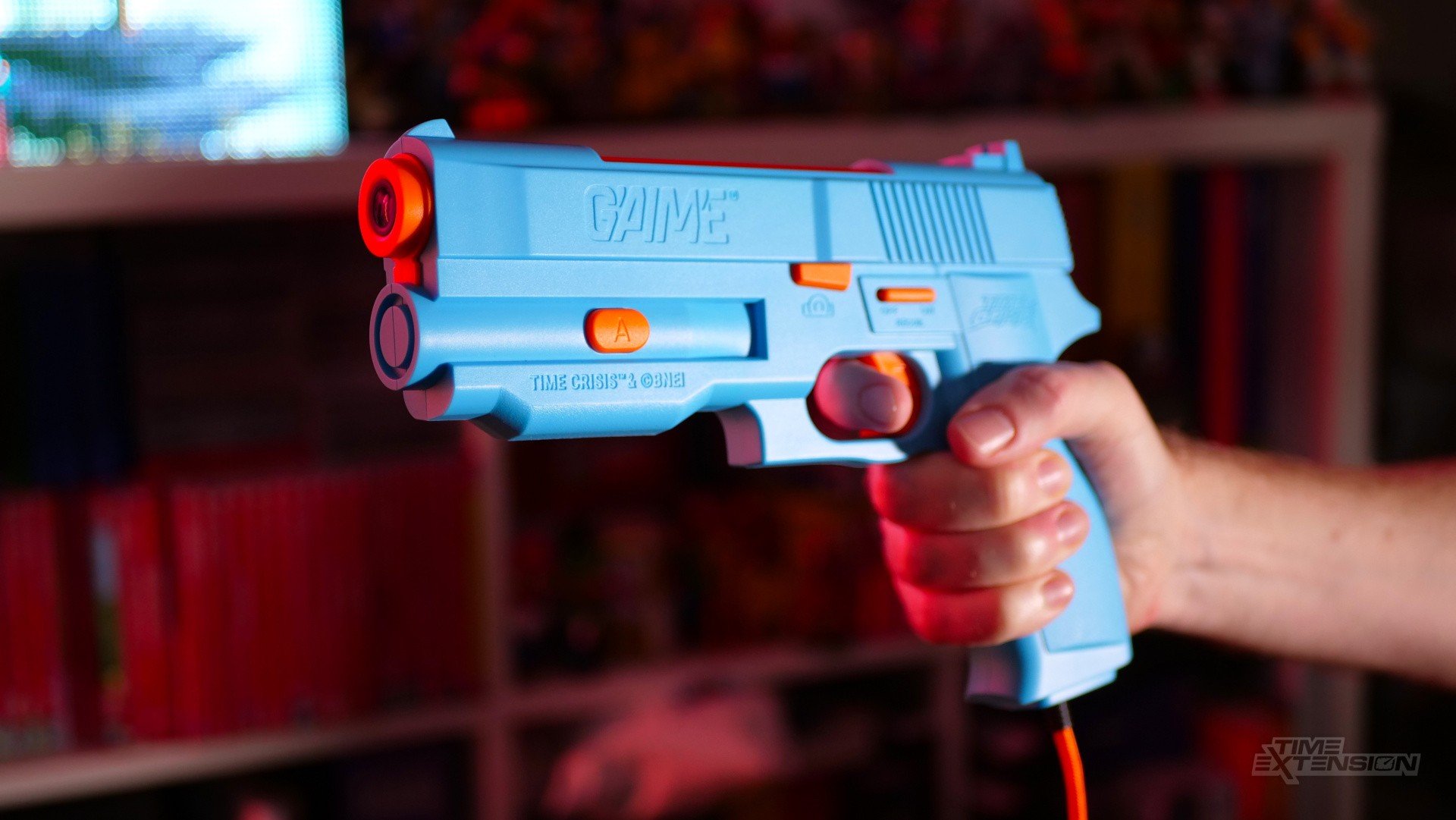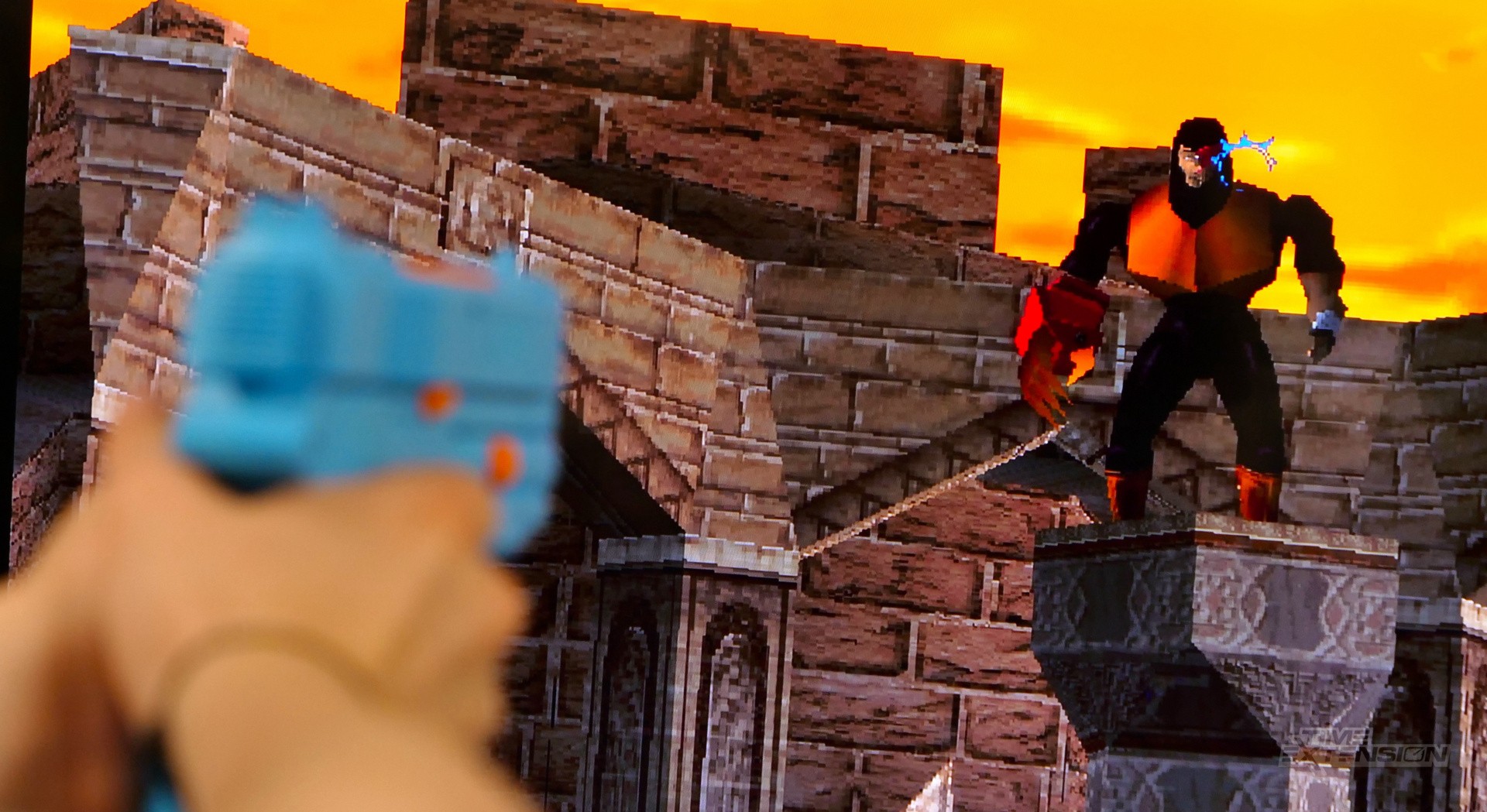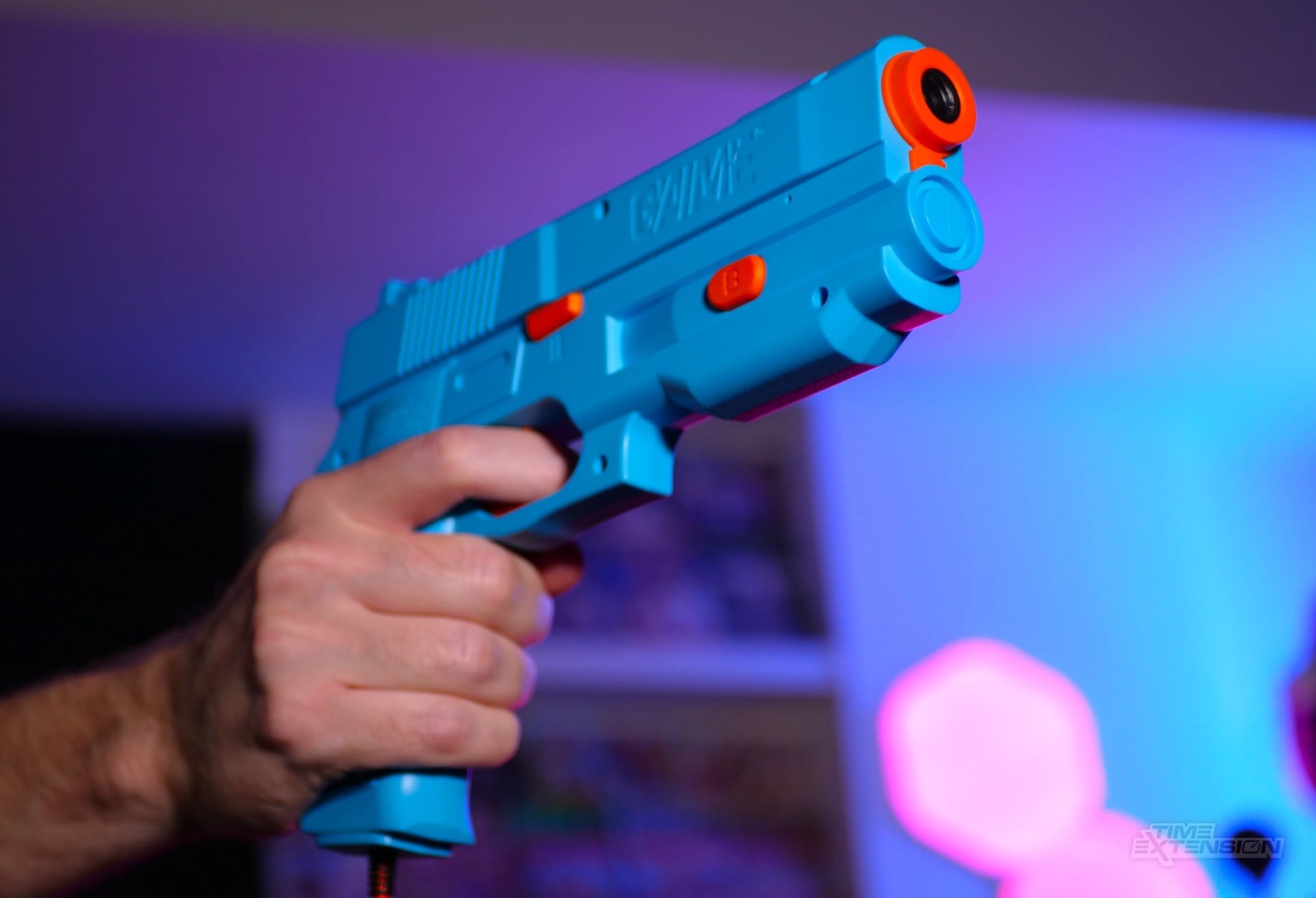
Tassei Denki used Tokyo Game Show 2026 to display two new prototypes for its G'AIM'E Light Gun system, labeled 'Pro' and 'Lite.' The company positioned the hardware as iterative advances on the existing G'AIM'E platform, which was reviewed by Time Extension in November 2025.
The demonstrations at TGS focused on accuracy and input methods rather than announcing commercial release plans.
At the show, the G'AIM'E Pro was presented as an evolution of the current consumer model.
Tassei Denki retained the basic form factor of the original G'AIM'E gun but emphasized improved accuracy and reduced latency in the prototype.
According to the developer's presentation and hands-on reporting, the Pro preserves the camera-based, AI-assisted tracking approach used by the original unit while refining sensor performance to tighten aim and responsiveness.
The G'AIM'E Lite represents a more distinct departure.
Rather than using camera-driven, AI-assisted tracking, the Lite adopts gyro-based motion sensing similar in principle to the Wii Remote.
Game Watch noted that gyro systems can introduce cursor drift over time, requiring occasional manual recalibration, but also reported that aiming on the Lite felt responsive with minimal perceptible lag.
Game Watch characterized both devices shown at TGS as technology demonstrations and made clear they are not intended for sale in their current form.
In journalistic terms: the developer presented the Pro and Lite as experimental prototypes and stated they will not be released commercially without further development and refinement.
Alongside the prototypes, Tassei Denki announced SKU changes for the existing G'AIM'E model.
The company will offer a Family Pack that includes two gun-type controllers and one system, and an Entry/Economy Pack that includes one gun-type controller and one system.
Notably, the pedal controller accessory commonly associated with arcade-style shooters such as Time Crisis is not included in either new bundle.
The TGS 2026 demonstrations underscore ongoing interest in light-gun peripherals and the technical trade-offs between camera-based AI tracking and gyro-based motion control.
While the Pro aims to polish the original G'AIM'E approach, the Lite opts for a simpler, gyro-centered design familiar to players who used the Wii Remote.
Tassei Denki’s next steps will be watched closely by fans of light-gun games and by developers exploring peripheral-driven gameplay on modern platforms, including titles that have historically appeared on services like the Nintendo eShop and systems such as the Nintendo Switch.
The demonstrations at TGS focused on accuracy and input methods rather than announcing commercial release plans.
At the show, the G'AIM'E Pro was presented as an evolution of the current consumer model.
Tassei Denki retained the basic form factor of the original G'AIM'E gun but emphasized improved accuracy and reduced latency in the prototype.
According to the developer's presentation and hands-on reporting, the Pro preserves the camera-based, AI-assisted tracking approach used by the original unit while refining sensor performance to tighten aim and responsiveness.
The G'AIM'E Lite represents a more distinct departure.
Rather than using camera-driven, AI-assisted tracking, the Lite adopts gyro-based motion sensing similar in principle to the Wii Remote.
Game Watch noted that gyro systems can introduce cursor drift over time, requiring occasional manual recalibration, but also reported that aiming on the Lite felt responsive with minimal perceptible lag.
Game Watch characterized both devices shown at TGS as technology demonstrations and made clear they are not intended for sale in their current form.
In journalistic terms: the developer presented the Pro and Lite as experimental prototypes and stated they will not be released commercially without further development and refinement.
Alongside the prototypes, Tassei Denki announced SKU changes for the existing G'AIM'E model.
The company will offer a Family Pack that includes two gun-type controllers and one system, and an Entry/Economy Pack that includes one gun-type controller and one system.
Notably, the pedal controller accessory commonly associated with arcade-style shooters such as Time Crisis is not included in either new bundle.
The TGS 2026 demonstrations underscore ongoing interest in light-gun peripherals and the technical trade-offs between camera-based AI tracking and gyro-based motion control.
While the Pro aims to polish the original G'AIM'E approach, the Lite opts for a simpler, gyro-centered design familiar to players who used the Wii Remote.
Tassei Denki’s next steps will be watched closely by fans of light-gun games and by developers exploring peripheral-driven gameplay on modern platforms, including titles that have historically appeared on services like the Nintendo eShop and systems such as the Nintendo Switch.